
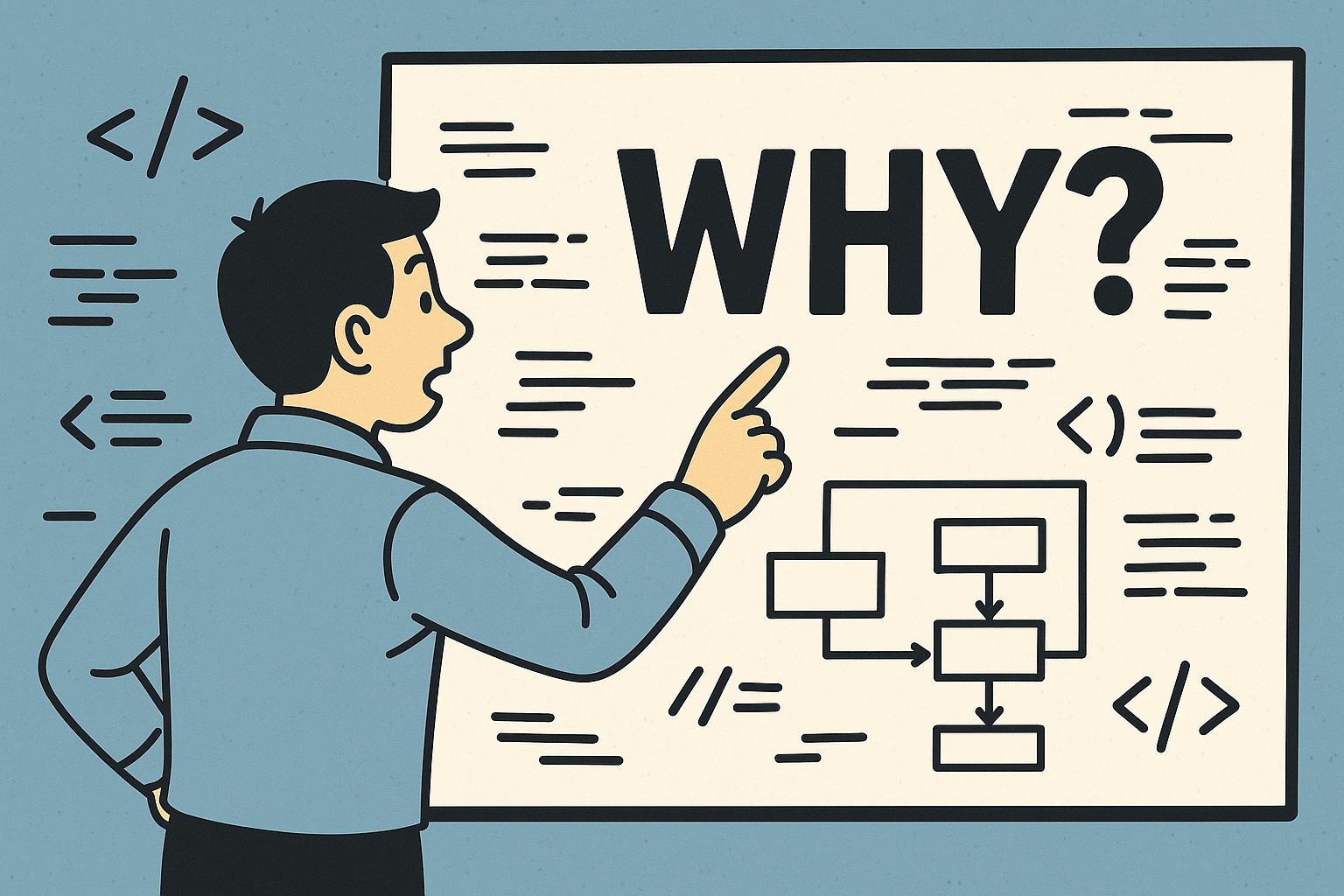
Through the years, one thing has consistently surprised me in the world of software development: how often teams implement requirements without ever asking why. A business stakeholder comes in with a list of features. A product manager documents them. A developer picks up a ticket and starts coding. Everyone is doing their part — but something crucial is missing. Nobody asked:
“Why are we building this?”
And without that question, we risk building the wrong thing — perfectly.
The “Requirement Factory” Trap
In many companies, there’s an invisible wall between business and engineering. On one side, the business defines the what. On the other, developers implement it without question. You might hear phrases like:
- “This came from the business, just estimate it.”
- “It’s already prioritized — let’s not overcomplicate it.”
- “We don’t need the full context, just follow the spec.”
I’ve seen this happen in teams where the role of the developer is reduced to someone who just ‘writes code’ based on specifications. But software engineers today are so much more than that. We design, we question, we collaborate, we improve. Our value doesn’t just lie in our ability to code — it lies in our ability to understand problems, shape solutions, and help teams and businesses move forward with confidence.
Why “Why?” Matters
Asking “Why?” isn’t about being annoying. It’s about understanding the purpose behind what we’re building or choosing.
- The business goal behind a feature or product
- The actual user or operational need
- Hidden assumptions in the request
- Whether that external service or design pattern really fits the use case
- Better alternatives we might not have seen otherwise
It’s like switching on the lights in a dark room — everything becomes clearer. Without the “Why”, we’re just guessing (but with great unit tests and lots of Kubernetes YAML).
What I Wish I Knew Earlier
Early in my career, I rarely asked “Why?”. Not because I didn’t want to — but because I was afraid.
Afraid of looking ignorant.
Afraid of slowing others down.
Afraid of asking something that “should already be obvious.”
I figured if I just nodded and implemented, everything would go smoothly. (Spoiler: it didn’t.) I suspect many younger engineers feel the same way. But here’s the truth: Asking “Why?” is not a sign of weakness — it’s a sign of maturity and ownership.
The people I looked up to — the ones who seemed confident and sharp — were the ones asking questions. They weren’t afraid to dig deeper. They didn’t pretend to know everything. They just wanted to understand, so they could build the right thing — ideally the first time.
A Personal Observation
In my own work, the most valuable technical decisions rarely came from following a perfect specification. Let’s be honest — perfect specs are as mythical as bug-free legacy systems.
Instead, they came from conversations that started with:
“Can you help me understand why this is needed?”
- Avoid building redundant functionality
- Offer simpler, more maintainable alternatives
- Identify edge cases that weren’t considered
- Strengthen trust between dev and business teams
Sometimes, asking “Why?” even led to the realization that the feature wasn’t needed at all. Which is always a good day — especially if you hadn’t written a line of code yet.
Our Job is More Than Code
Too often, we reduce the role of a software engineer to just “writing code.” But the real value lies in building the right things — not just building things right.
Asking “Why?” is a sign of professionalism, not resistance. It shows you’re invested in the outcome, not just the output. If we don’t understand the Why, how can we truly understand the What?
Let’s Normalize “Why?”
If you’re a developer, don’t be afraid to speak up. Be curious. Ask questions. You’re not being difficult — you’re being diligent.
If you’re a product owner or business stakeholder, invite developers into the problem space, not just the solution space. The earlier we understand the why, the better the what will be.
And if you’re a junior engineer, here’s a small reminder:
You’re not expected to know everything — but you’re expected to want to understand.
How to Ask “Why?” Without Causing Friction
Asking “Why?” is powerful, but tone and timing matter. You’re not trying to challenge authority or prove someone wrong — you’re trying to help the team make better decisions together.
Here are a few ways to ask ‘Why?’ that feel collaborative instead of confrontational:
- “Just so I understand the context better, why are we choosing this approach?”
- “What’s the main problem we’re solving here?”
- “Would it make sense to explore a couple of options before we commit?”
- “Is this driven by a specific constraint or requirement?”
Tone is key. Be curious, not combative. In most cases, people are happy to explain their reasoning — and might even appreciate the chance to clarify their thinking.
Final Thought
The next time someone hands you a requirement, try this:
Before you estimate, before you architect, before you code —
Just ask: “Why?”
It might be the most important thing you do all day.
(And if it turns out nobody knows the answer — well, now that’s a conversation worth having.)