
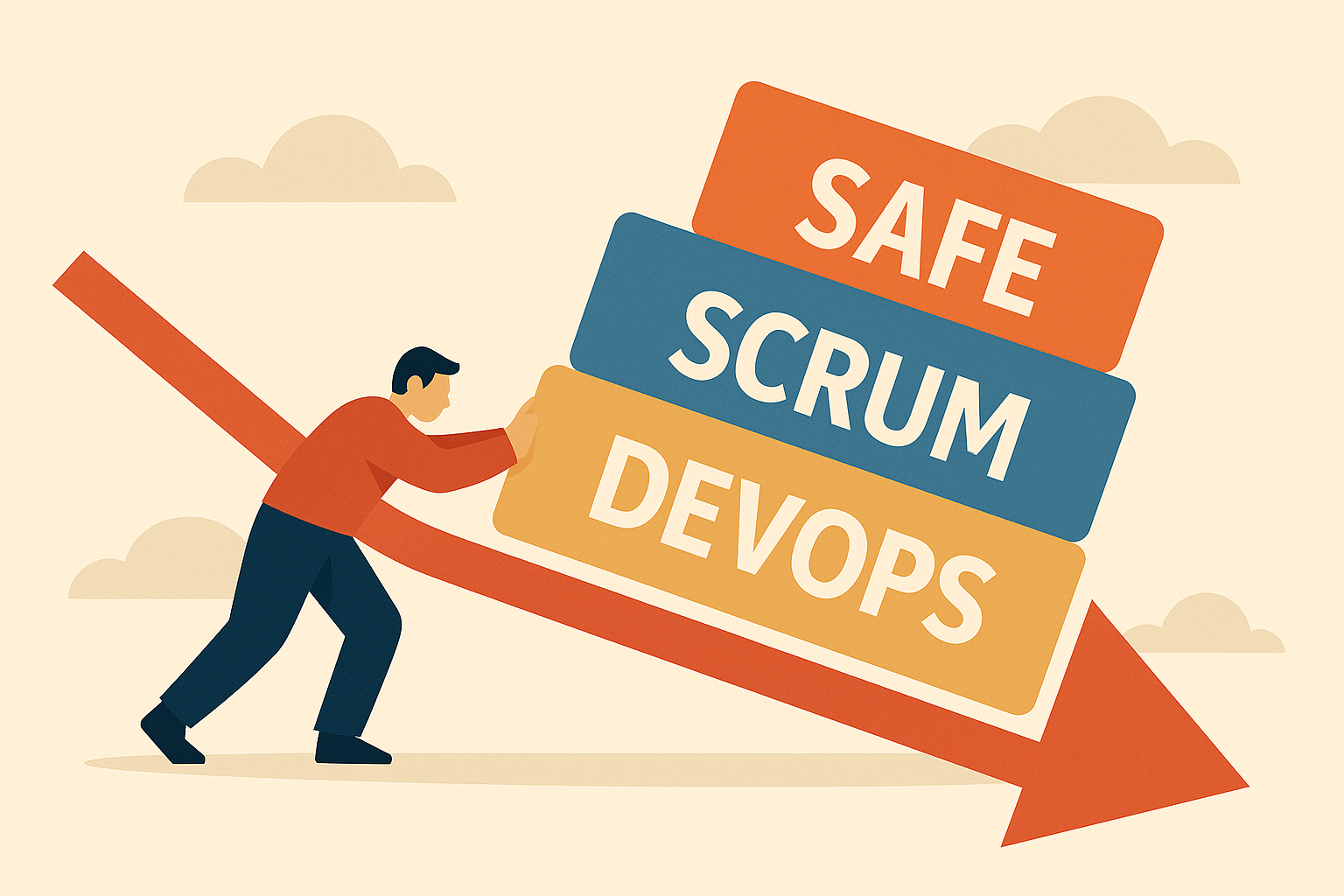
Modern tech organizations are under pressure to move fast, stay reliable, and deliver customer value at scale. In response, many adopt popular frameworks like SAFe, Scrum, and DevOps. These frameworks promise structure, scalability, and speed — but when applied blindly or rigidly, they can introduce a new kind of drag: framework overload.
In this post, we’ll look at how frameworks, when over-prescribed or misunderstood, can slow teams down rather than enabling them — and how to avoid that trap.
Frameworks: Crutches or Enablers?
Frameworks are tools — not destinations. They exist to solve problems, reduce chaos, and help teams deliver value more effectively. But there’s a fine line between:
- Using a framework to solve a real problem
- Using a framework as a crutch to avoid critical thinking
When organizations adopt SAFe, Scrum, or DevOps by the book without tailoring them to their context, they often:
- Add ceremonies without clarity
- Introduce roles without empowerment
- Layer on tools without alignment
The result? Teams become busier, not better.
The Rise of “Process Debt”
Just as technical debt accumulates when systems are built without maintainability in mind, process debt builds up when organizations stack rituals, meetings, metrics, and tools without asking:
“Is this still helping us deliver value?”
Symptoms of process debt include:
- Standups that last 45 minutes
- Retrospectives with no follow-up actions
- Burdensome PI Planning sessions that feel disconnected from real work
- DevOps teams who own all CI/CD pipelines, but application teams can’t deploy independently
Over time, these well-intentioned processes become a drag on flow, not a boost.
A Real-World Example: SAFe Gone Too Far
At a previous company, SAFe became more important than delivering value. We had the full cast of roles — Product Owners, RTEs, Scrum Masters — and quarterly PI Planning sessions that felt more like ceremony than strategy.
Stories moved slowly, approvals piled up, and cross-team dependencies made small features complex. One developer joked, “We’re building a perfect backlog — just not a product.”
The framework itself wasn’t the issue — clinging to it too rigidly was.
A Real-World Example: The DevOps Silo Trap
In a SaaS company I supported, a dedicated DevOps team owned everything: CI/CD, infrastructure, monitoring. Product teams had to open tickets to deploy or debug.
Despite good intentions, it recreated the old silos — just with more YAML. Eventually, the company moved to a platform model with self-service tools and shared observability.
The wall between Dev and Ops came down — and delivery sped up.
Principles for Leaner, Outcome-Focused Adoption
1. Start With the Problem, Not the Framework
Only introduce process when there’s a clear friction point it solves. Avoid process for the sake of process.
2. Treat Frameworks as Modular
SAFe, Scrum, and DevOps are not all-or-nothing. Use what serves your context — skip the rest.
3. Optimize for Flow
Map your value stream. If a framework slows down delivery, simplify it. If it creates bottlenecks, remove them.
4. Favor Principles Over Prescriptions
Focus on outcomes like lead time, change fail rate, and customer feedback — not checklists of roles or ceremonies.
5. Continuously Inspect and Adapt
What worked last quarter might be process debt today. Keep challenging assumptions.
Final Thought
Frameworks aren’t the enemy — misusing them is. SAFe, Scrum, and DevOps can be powerful enablers when tailored to your organization’s needs.
But if you find yourself doing ceremonies nobody values, enforcing roles nobody understands, or building pipelines nobody owns — you’re not scaling agility, you’re scaling complexity.
Start with outcomes. Reduce friction. Empower teams. And maybe — just maybe — ask why you’re doing what you’re doing in the first place.
It might be the most agile thing you do all week.